


Read time: 5 minutes
What would you do if you discovered your bones were in worse shape than your 80-year-old mom’s? That’s exactly what happened when I was diagnosed with osteoporosis at 53.
Looking back, it makes sense. I wasn’t the kid jumping off playground equipment or flipping into handstands in gymnastics. Ballet was much more my speed—graceful, controlled, lower-impact. I avoided rougher activities that could have been building stronger bones.
Last week, I questioned why we wait until 65 to check bone density and shared my DexaFit results from age 52—a T-score of -0.60 that placed me in the “Fair” range.
That was body composition scanning. Two weeks ago, I got my first DEXA Axial scan specifically for bone density. The results were a wake-up call I didn’t see coming.
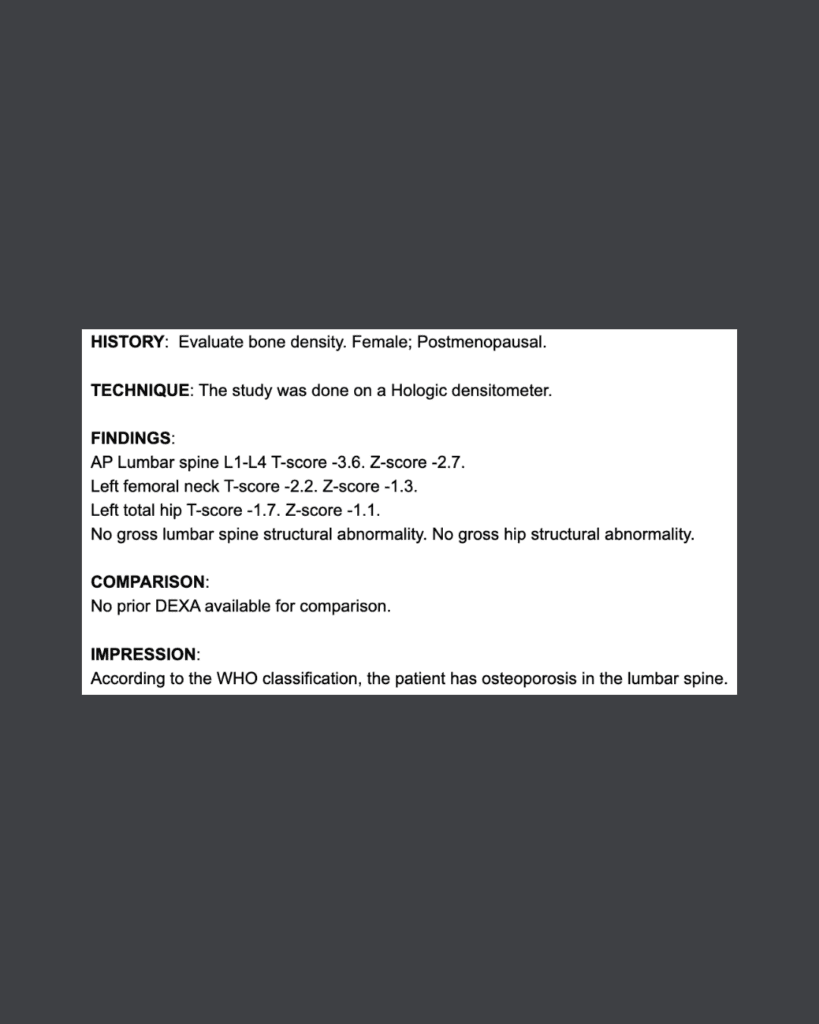
My DEXA Axial Results: A Reality Check
FINDINGS:
- AP Lumbar spine L1-L4 T-score -3.6, Z-score -2.7
- Left femoral neck T-score -2.2, Z-score -1.3
- Left total hip T-score -1.7, Z-score -1.1
IMPRESSION: According to WHO classification, I have osteoporosis in the lumbar spine.
To put this in perspective: T-scores compare your bone density to a healthy 30-year-old. A T-score of -2.5 or lower indicates osteoporosis. My lumbar spine scored -3.6—significantly into osteoporosis territory.
Is Bone Density Just Genetics?
Probably not. My 80-year-old mom recently had her own DEXA scan, and despite leveling-up my exercise significantly in the last 5 years, her femoral and lumbar spine scores are better than mine. She doesn’t have osteoporosis.
This reinforced something I wrote about last week: your peak bone mass at 30 significantly influences your bone health for decades to come. My mom clearly built better bone density in her younger years than I did in mine.
The research backs this up. According to the National Institute of Health, “While genetic factors play a significant role in determining bone mass, controllable lifestyle factors such as diet and physical activity can mean the difference between a frail and strong skeleton.”
My 5-Step Bone Density Rebuild Plan
I’m treating this diagnosis as actionable data, not a life sentence. While bisphosphonates are often prescribed for osteoporosis, I’m prioritizing lifestyle interventions. Here’s exactly what I’m implementing:
1. Resistance Training
I’m working toward using heavier weights in my Bar Method classes and incorporating more bone-loading exercises at home. Weight-bearing and resistance exercises signal bones to maintain and build density.
2. Strategic Supplementation
Adding vitamin K2 and calcium to my existing vitamin D regimen. These three nutrients work synergistically—vitamin D helps absorb calcium, K2 directs calcium to bones rather than arteries, and all three support bone formation
If you’re like me, you’ve heard of vitamin K, but had no idea K1 and K2 come from different sources and have slightly different functions in the body (if you eat dark green leafy vegetables, your K1 is likely covered). Research published in Open Heart found an alarmingly high prevalence of vitamin K deficiency in the general population—proof that digging deeper than standard health advice pays off.
Important note: Discuss vitamin K2 supplementation with your healthcare provider, especially if you’re taking blood-thinning medications. One of the crucial roles vitamin K plays in the body is blood clotting.
3. Targeted Nutrition
I’m adding natto (fermented soybeans) to my diet for additional K2. While the taste takes getting used to, natto contains the highest natural levels of vitamin K2 available.
4. Balance and Mobility Maintenance
Decades of yoga have given me a strong foundation here. Balance and mobility become essential for anyone managing bone loss. Fewer falls mean lower fracture risk.
5. Exploring Specialized Bone-Loading Technology
A friend with osteoporosis recommended OsteoStrong, a specialized resistance system designed specifically for bone building. I’m checking it out to see if it can speed up my bone rebuilding.
Why This Experience Validates Early Screening
This is exactly why I questioned the standard timeline in last week’s post. Had I waited until 65 for routine screening, I would have missed 12 years of potential intervention.
If you have risk factors—menopause, small frame, family history, sedentary lifestyle, certain medications, or dietary patterns—discuss screening with your healthcare provider.
What started as an unexpected diagnosis became a roadmap for rebuilding. The research is clear: lifestyle factors can make the difference between a frail and strong skeleton—regardless of where you’re starting from.
Thanks for reading!
Like this post? The newsletter is the blog, plus. Subscribe to You Are What You Read — one email a month on redefining your Next 50. Only what works.
References & Additional Reading
Bone Health and Genetics:
- National Institutes of Health. (2012). Bone Health and Osteoporosis: A Report of the Surgeon General. Chapter 2: The Basics of Bone in Health and Disease. https://www.ncbi.nlm.nih.gov/books/NBK45503/
Bone Health and Exercise:
- University of Florida Health News. (2003). UF researcher finds vitamins, regular exercise and weight training may improve bone density. https://ufhealth.org/news/2003/uf-researcher-finds-vitamins-regular-exercise-and-weight-training-may-improve-bone-density
Vitamin K2 and Bone Health:
- Knapen, M. H., et al. (2013). Three-year low-dose menaquinone-7 supplementation helps decrease bone loss in healthy postmenopausal women. Journal of Nutrition, 143(9), 1437-1442. https://www.sciencedirect.com/science/article/pii/S0022316622082499
- Gundberg, C. M., et al. (2012). Vitamin K status and bone health: an analysis of methods for determination of undercarboxylated osteocalcin. Journal of Clinical Endocrinology & Metabolism, 97(9), 3109-3117. https://pmc.ncbi.nlm.nih.gov/articles/PMC4566462/
Image credits: Photo by cottonbro studio, Photo by With Mahdy on Unsplash
This post does not constitute medical advice. Please consult with your healthcare provider regarding your specific health needs.