


Read time: 9 minutes
Convincing your parents to eat only what you serve for seven straight days? That takes either supreme confidence in your methods or mild insanity. Fortunately, the results proved it was the former.
Six weeks ago, I flew to Portland, Oregon to put that confidence to the test—turning my parents into guinea pigs for a 7-day plant-based diet intervention designed to produce rapid, measurable health improvements.
From Personal Success to Proof of Concept
A whole food, plant-based approach to eating works—and the evidence is overwhelming. Over the years, this way of eating has solved for getting my biomarkers in range, losing weight, maintaining a healthy weight, and optimizing my sleep, mood, energy, and cognitive function. I’m healthier in my 50s than I was in my 20s and 30s, which shouldn’t be surprising given that lifestyle choices determine 85-90% of our health outcomes.
I didn’t choose this approach for ethical reasons (though I appreciate those benefits). I chose it because the research on health outcomes is undeniable. My recent 14-day continuous glucose monitor experiment demonstrated this—despite eating foods that online influencers claim will “spike your blood sugar,” my body maintained healthy glucose levels because of my overall lifestyle system.
But there’s a step between personal success and business viability. Before I could confidently offer a wellness retreat focused on optimal nutrition—which based on the research, means whole plant foods, I needed to test whether I could execute my specific vision—a retreat that focuses on rapid, measurable results while appealing to people who may never consider themselves “plant-based” or “vegan.”
Enter my parents—the perfect test subjects. I visit them regularly anyway, their kitchen is familiar territory, and I wouldn’t need to rent an Airbnb or coordinate with strangers. Plus, parents don’t sugarcoat feedback. If this nutritional approach was going to work for regular people focused on health outcomes rather than dietary labels, it had to work on them.
My hypothesis: Take complete control of people’s food choices for seven days using evidence-based nutrition principles, add some strategic lifestyle guidelines, and they’ll experience measurable health improvements. Not just “feeling better,” but actual, quantifiable changes that prove their body’s remarkable capacity for rapid positive change.
The retreat succeeds when participants realize they have far more control over their health outcomes than they’ve been led to believe. We can’t control everything, but we can control enough to dramatically impact how we feel, function, and age.

The Vision: A Different Kind of Wellness Retreat
Most wellness retreats fall into two categories: spa vacations that prioritize relaxation over real health improvements, or outdated facilities that feel more like summer camp than somewhere you’d actually want to spend a week. Neither delivers what high-performers actually need.
I see a gap in the market for something that combines both exceptional experience and measurable health outcomes. Think modern, thoughtfully designed spaces that feel more like a curated co-working space than a traditional wellness center—somewhere that attracts people who wouldn’t normally consider a “retreat” but are serious about optimizing their health.
The goal isn’t just to feel good during your stay (though you should). It’s to leave with quantifiable evidence that your body can transform quickly when given the right inputs. Real biomarker improvements. Measurable changes. Evidence that the week actually moved the needle on your health, not just your stress levels.

The 7-Day Experiment: Rules and Guidelines
My parents agreed to eat only the food I purchased and/or served for 7 days. Anything else in their fridge or pantry was off limits.
The Non-Negotiable: Food Rules
This was the heart of the experiment. For seven days, I had complete control over their nutrition. Every meal, every snack, every ingredient was carefully selected based on four key principles: maximum nutrient density per calorie, diverse whole plant foods to hit all essential micronutrients, balanced macronutrients (carbohydrates, protein, and fat), and abundant fiber—which supports gut health (critical for immune function), helps lower cholesterol and blood sugar, reduces chronic disease risk, and promotes satiety for natural weight management.
The goal wasn’t restriction—it was optimization. Instead of limiting what they couldn’t have, I focused on flooding their systems with the most beneficial foods possible.
The Supporting Guidelines: Lifestyle Additions
Beyond food, I suggested several lifestyle changes that research shows amplify the benefits of optimal nutrition. These weren’t strictly enforced like the food rules, but I encouraged them to aim for:
- 90 ounces of water daily (most people are chronically dehydrated)
- No food after 7pm with a 12-hour overnight fast (giving their digestive systems a break)
- A 10-minute walk or light gardening after each meal (supporting blood sugar regulation)
- 8,000 steps per day (modest but meaningful movement)
- No electronics from 8pm to 8am (prioritizing sleep quality)
Some of these guidelines worked better than others—but I’ll save those details for next week’s results post.
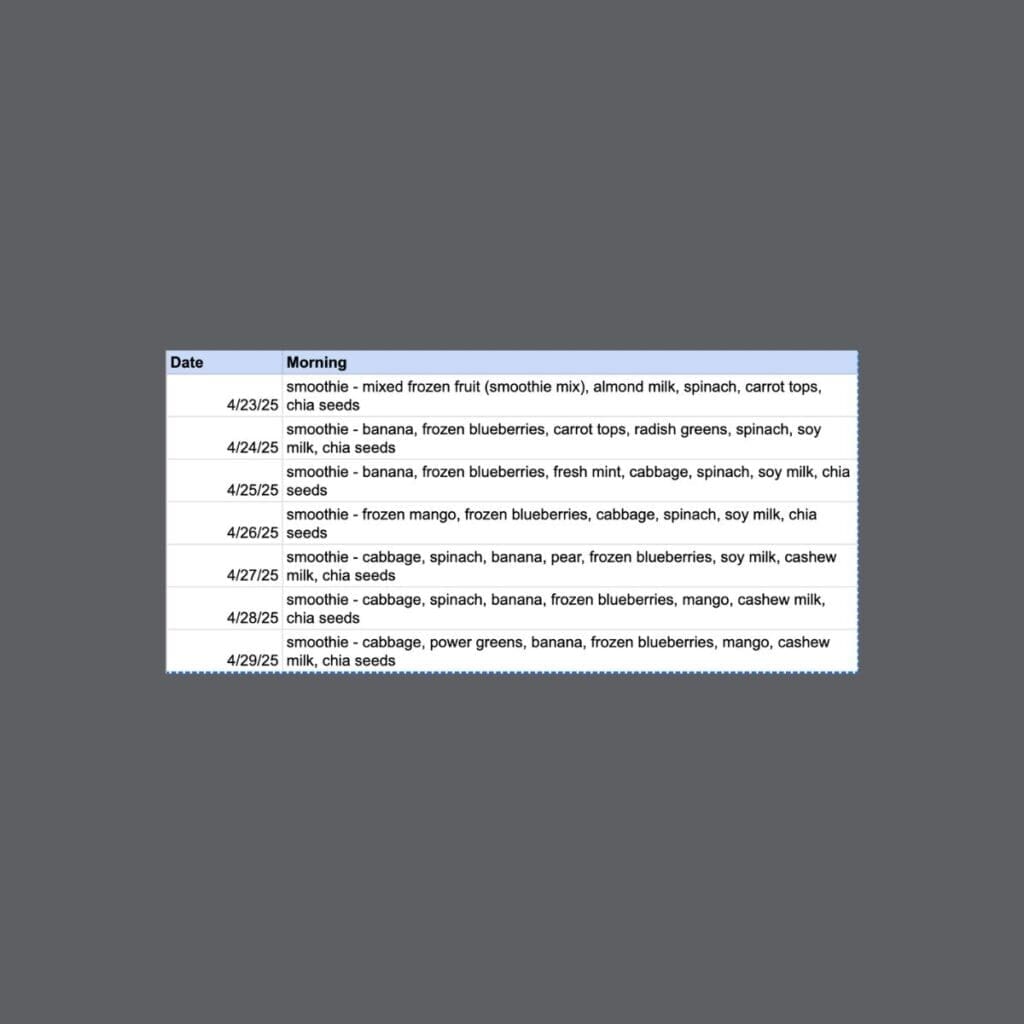
What We Tracked (And What I Wish We Could Have)
Here’s what we were able to measure in this home-based pilot—and why each metric matters for understanding rapid health changes.
Data I Had Access To:
- Weight – The most accessible metric, and often the first place people see changes when optimizing nutrition
- Resting Heart Rate (Apple Watch) – A key indicator of cardiovascular fitness and recovery, though my parents’ heart medications limited the relevance of this data
- Daily Steps (Apple Watch) – Simple but powerful measure of overall activity and movement patterns
- Glucose Levels (step-dad only, via continuous glucose monitor) – Critical for understanding how food choices affect blood sugar stability and energy
What I’d Want in a Full Retreat Environment:
- Waist Circumference – A valuable complement to weight tracking for understanding body composition shifts
- Sleep Quality Data (Whoop or Oura ring) – Sleep is where the magic happens for memory consolidation, immune system function, and cellular repair
- Comprehensive Metabolic Panel (before and after) – A standard laboratory assessment for tracking biomarker improvements, requiring medical professional involvement
While weight is a valuable health indicator, the most meaningful insights come from tracking multiple data points together. In a dedicated retreat setting, I’d want access to lab-quality data that can demonstrate the profound changes possible when you optimize all inputs simultaneously. But even with limited metrics, the changes we documented were compelling—which I’ll share in next week’s results post.
For anyone using fitness trackers like Whoop, Oura Ring, Garmin, Fitbit, or Apple Watch to monitor health changes, my Metrics that Matter with Whoop guide shows you exactly which metrics to focus on and how to use them for sustained progress.
The Menu: What Made the Cut (And What Didn’t)
Every ingredient served during the seven days was carefully selected using five non-negotiable criteria: whole plant foods, minimally processed, oil-free, refined sugar-free, and low saturated fat. For any store-bought items, I chose products with minimal, recognizable ingredients.
What Made the Cut:
The foundation was vegetables (raw and cooked), fruits, whole grains, and legumes—foods that deliver maximum nutrition per calorie while providing complete nutritional profiles. Even prepared foods like baba ghanoush had to meet the standards: store-bought but oil-free, containing only eggplant, tahini, and spices.
What Didn’t:
Animal products, highly processed foods, refined sugars, alcohol, and added oils were completely eliminated. Even “healthy” foods like nuts were excluded—not because they’re unhealthy, but because they’re calorie-dense and could interfere with the rapid results I was testing for. Every exclusion served the larger goal: creating an environment where the body could demonstrate its remarkable capacity for quick positive change.
The Real Test:
This wasn’t about perfection or restriction—it was about proving that food quality matters more than most people realize. Many people think they’re eating healthy but aren’t seeing results because the foods they’re consuming, while marketed as nutritious, simply don’t move the needle.
This controlled experiment was designed to bridge that gap between effort and outcomes, creating the foundation for what I envision as a modern wellness experience where participants leave with undeniable proof of what’s possible.
What’s the healthiest change you’ve made that didn’t deliver the results you expected? Send me a note and let me know—I’d love to hear about your experiences with the gap between good intentions and real results.
Stay tuned for next week’s post, where I’ll share the actual outcomes: biomarker changes, discoveries (both expected and unexpected), and what this experiment revealed about rapid health transformation.
Thanks for reading!
Like this post? The newsletter is the blog, plus. Subscribe to You Are What You Read — one email a month on redefining your Next 50. Only what works.
References & Additional Reading
Fiber Benefits:
- Dietary fiber benefits and recommendations. Mayo Clinic. https://www.mayoclinic.org/healthy-lifestyle/nutrition-and-healthy-eating/in-depth/fiber/art-20043983
Whole Food Plant-Based Diet Research:
- McMacken M, Shah S. A plant-based diet for the prevention and treatment of type 2 diabetes. Journal of Geriatric Cardiology. 2017;14(5):342-354. https://www.ncbi.nlm.nih.gov/pmc/articles/PMC3662288/
- Tuso PJ, Ismail MH, Ha BP, Bartolotto C. Nutritional update for physicians: plant-based diets. The Permanente Journal. 2013;17(2):61-66. https://www.ncbi.nlm.nih.gov/pmc/articles/PMC3662288/
- McMacken M, Shah S. A look at plant-based diets. Missouri Medicine. 2021;118(3):233-238. https://pmc.ncbi.nlm.nih.gov/articles/PMC8210981/
- Landry MJ, Ward CP, et al. Health benefits of a plant-based dietary pattern and implementation in healthcare and clinical practice. American Journal of Lifestyle Medicine. 2024. https://journals.sagepub.com/doi/full/10.1177/15598276241237766
- What is a plant-based diet and why should you try it? Harvard Health Publishing. 2024. https://www.health.harvard.edu/blog/what-is-a-plant-based-diet-and-why-should-you-try-it-2018092614760
Image credit: Photo by Sajjad Sabbir
This post does not constitute medical advice. Please consult with your healthcare provider regarding your specific health needs.