


Read time: 5 minutes
Updated August 2026
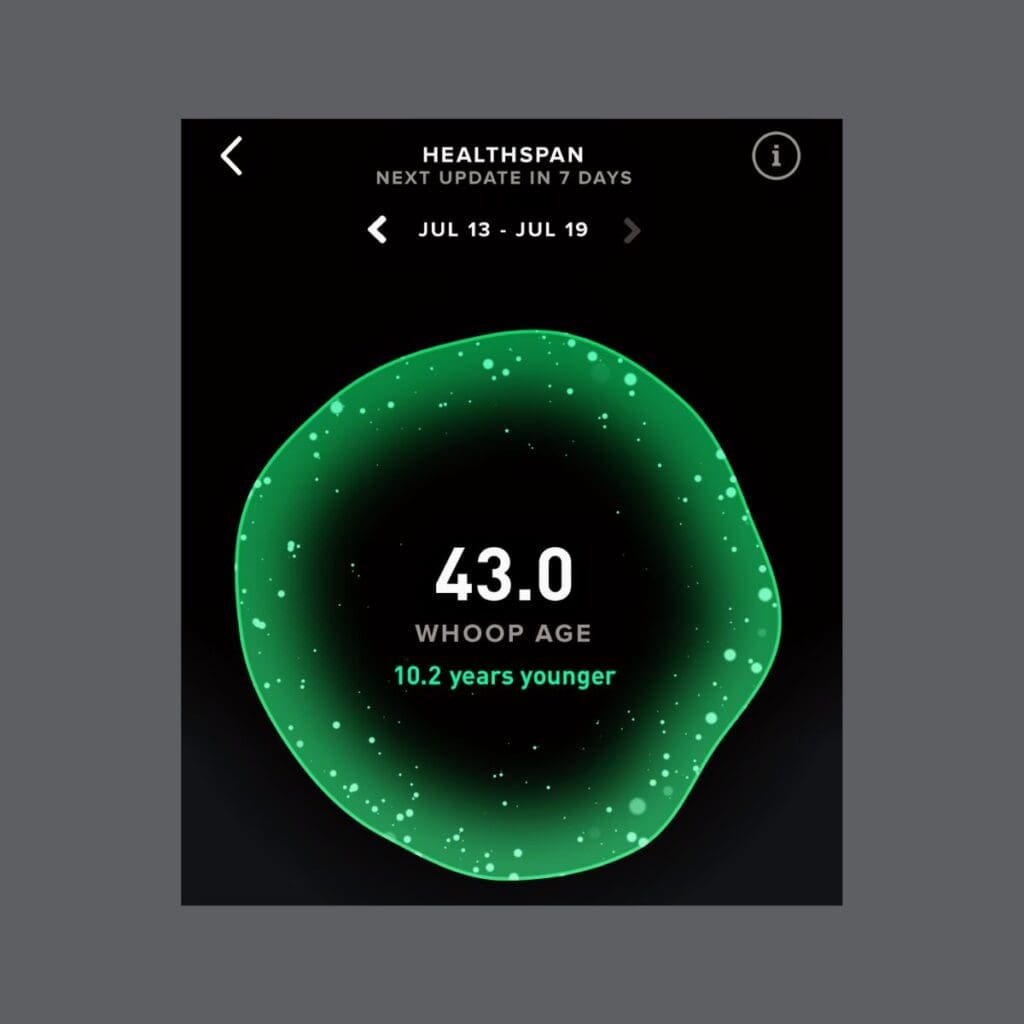
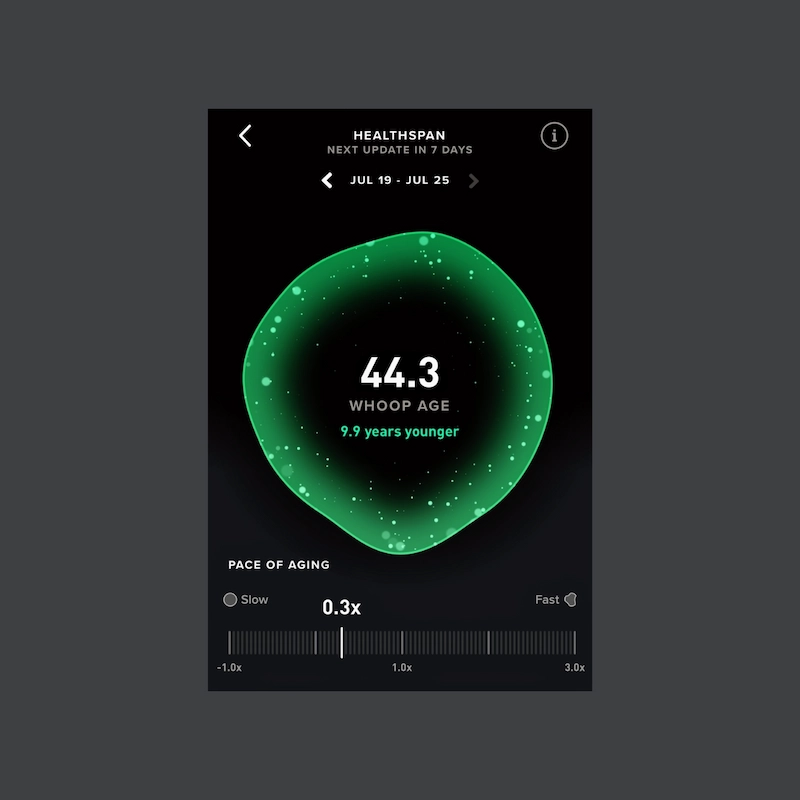
My Whoop device delivers a weekly insight I’ve come to count on. In July 2025 it put my biological age at 43.0. My chronological age was 53. A year later: 44.3, against a chronological age of 54. Whichever way I look at it: roughly a decade.
Whoop gives me a decimal. Not 45. I’ll take it.
That gap is the difference between lifespan and healthspan — and why one matters far more than the other.
Healthspan vs Lifespan: The Metric That Matters
Most of us treat aging as something that happens to us — inevitable decline we can’t control. The better measure is healthspan: how many years we’ll live in good health, free from chronic disease and disability. And it’s built more from consistent behavior than from genetics.
Here’s the sobering reality: healthy life expectancy in the US is 66.2 years, while overall life expectancy is 79.1.
That’s roughly 13 years spent in poor health.
What Is Whoop Age?
Whoop’s healthspan feature offers insight into something most of us never see — the difference between our biological and chronological age. I’ve had Whoop on my wrist since 2023. Fifteen years of basic step counting with Fitbit, and then something better came along. That’s usually all it takes.
The healthspan update introduced two key metrics:
Whoop Age: your body’s physiological age, based on long-term health data including sleep quality, exercise strain, and fitness markers.
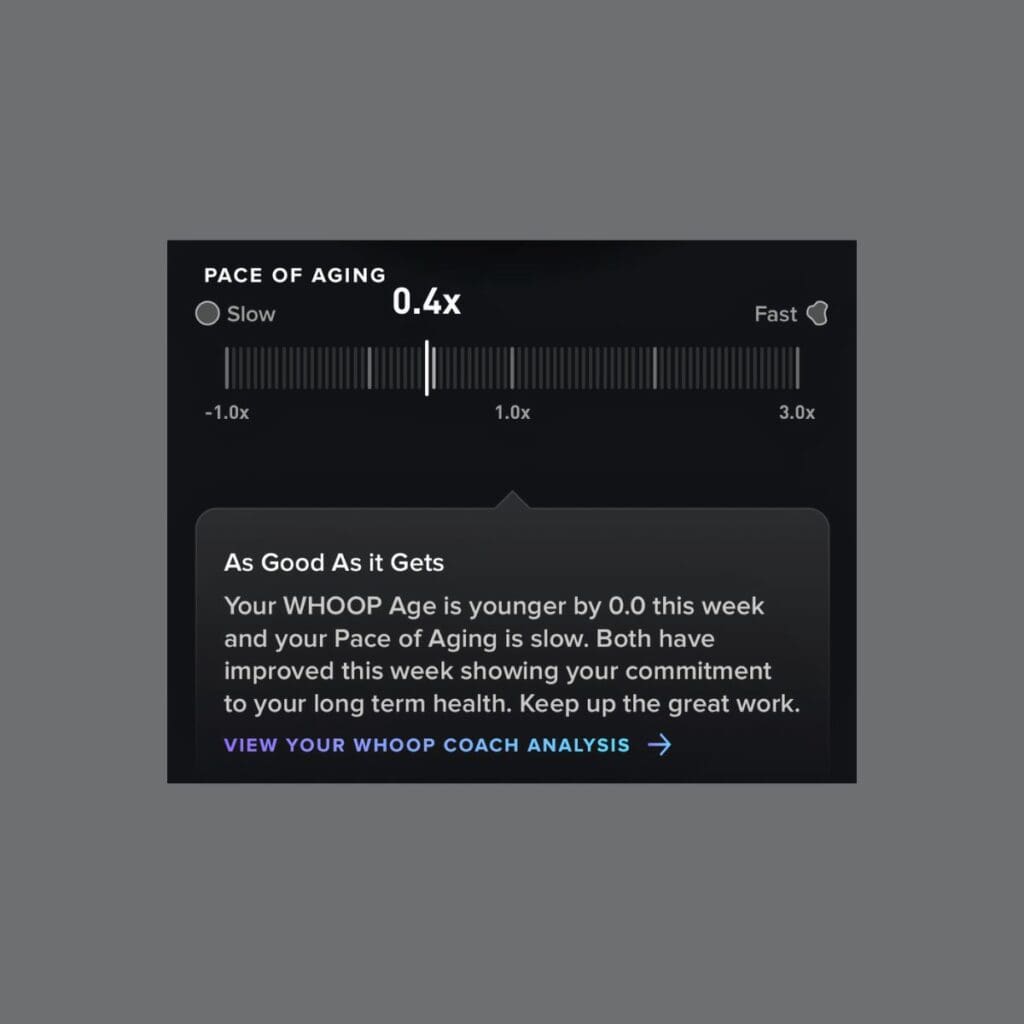
Pace of Aging: the rate at which your Whoop Age is changing. Mine has ranged from -0.7x to 0.3x, all well below the standard 1.0x rate — where biological age increases at the same rate as time. -1.0x is the slowest pace Whoop measures.
One year of the same metric. Whoop measures against my age in decimals — 53.2 then, 54.2 now — so that’s a gap of 10.2 years in 2025 and 9.9 today. Twelve chronological months, 1.3 biological years. Not a dramatic swing — and that’s the point. The number moves slowly, which is what you want from a metric meant to track a decade of habits rather than last week’s workout.
The Science Behind the Numbers
Whoop calculates these metrics using data points that research has linked to longevity and health outcomes.
For Whoop Age:
- Sleep hours and consistency
- Weekly time in different heart rate zones
- Strength training and functional movement time
- Daily steps
- Resting heart rate and VO2 max
- Lean body mass (when available)
For Pace of Aging:
- 30-day trends in all Whoop Age factors
- Recent changes in sleep, strain, fitness, and recovery patterns
- Comparison to your historical performance
These aren’t arbitrary metrics. They’re the physiological markers research consistently links to how we age and our risk for chronic disease.
Is Whoop Age Accurate?
Yes — with a caveat about which part you mean. The inputs are well validated: measured against ECG across 536 nights, WHOOP’s overnight resting heart rate came within about 3% and HRV within about 8%. Sleep duration is reliable; sleep staging is closer to a good estimate.
The composite is a different question. Whoop Age combines those inputs through a proprietary algorithm that hasn’t been independently validated. I trust the direction it moves. I hold the decimal loosely.
Accuracy isn’t the same as coverage. My bone density came back osteoporotic at 53 the same year my Whoop Age read a decade younger. Both were correct. One measured cardiovascular and sleep behavior; the other measured something no wrist sensor can see.
Whoop Age is excellent at showing whether your daily inputs are trending the right way. It’s not a screening tool, and a good number is not a reason to skip the tests that look at what a wrist strap can’t.
What If Your Whoop Age Is Older Than Your Actual Age?
I got the osteoporosis version of this news in 2025. It’s a bad week, and then it’s a project.
What’s easy to miss in that moment is this — it’s a snapshot of your recent habits, not a prediction of your future.
Look back at that list above: sleep, heart rate zones, strength training, steps. Notice what’s not on it. Your genetics. Your medical history.
Every input is a behavior — which means every input dragging your number up is an input you can change. That’s not a consolation prize. That’s the entire point of the metric. And the research backs the premise: studies consistently show that 80–90% of chronic illnesses are influenced by lifestyle factors.
Now check your Pace of Aging. Whoop Age tells you where past habits have left you. The pace tells you which direction you’re headed right now — and it responds to changes within weeks, not years.
Start here: Open your Whoop Age breakdown and find your single worst input. Just one. Work on it for 30 days — not perfectly, only consistently — and watch what happens.
My Whoop Age specifically has read 9–10 years younger since the feature launched, so I haven’t lived that particular turnaround.
That number wasn’t built overnight — it’s more than a decade of focusing on nutrition, then getting serious about exercise in 2022, then adding weight training in October 2025. One input at a time, stacked over years. The metric rewards the inputs.
Yours will too.
What’s Next
Data without action is interesting information and nothing more. Want the specific habits behind my Whoop Age results? I’ve shared the practical “how” in my breakdown of the four data-driven habits that keep my biological age a decade younger.
Your biological age isn’t determined by your birthday. It’s determined by your choices.
Thanks for reading!
Like this post? The newsletter is the blog, plus. Subscribe to You Are What You Read — one email a month on redefining your Next 50. Only what works.
References & Additional Reading
- Healthspan & WHOOP Age: Pace of Aging Guide – Whoop
- Validation of nocturnal resting heart rate and heart rate variability in consumer wearables – Physiological Reports
- Healthy life expectancy by county, race, and ethnicity in the USA, 2009–19 – The Lancet
- Diet, nutrition and chronic diseases in context – WHO/FAO
This post does not constitute medical advice. Please consult with your healthcare provider regarding your specific health needs.