


Read time: 7 minutes
Updated August 2026
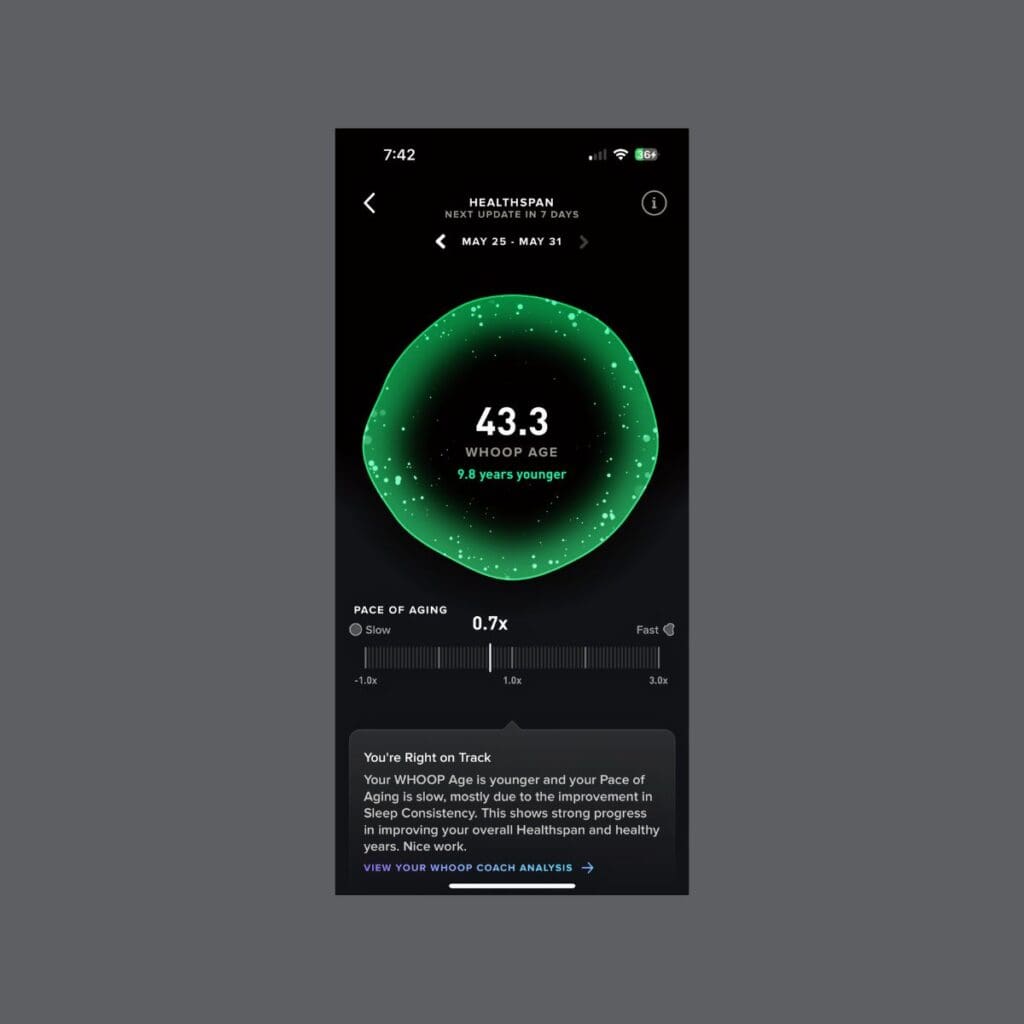
At 54, my fitness tracker says my biological age is 44.3 — 9.9 years younger than my birthday. That’s not luck. It’s a series of lifestyle habits I’ve studied, experimented with, and maintained for years.
When Whoop launched their healthspan feature calculating “Whoop Age” — a science-backed look at how your daily habits impact your long-term health — I wasn’t surprised by my results. I’ve since written about what Whoop Age measures, and what it misses; this post is about the habits behind the number. My health has come first for over a decade.
I want to take full advantage of my 50s and 60s. Freedom and motivation are core to who I am. I don’t intend to lose either.
Why I Choose Data-Driven Health: From Fitbit to Whoop
My fitness tracker history dates back to 2013 when I purchased my first Fitbit. Who else had the Fitbit that clipped onto your waistband? And lost a few? I wore a Fitbit for a decade before switching to Whoop in 2023. I learned I was motivated by health data — in those early days it was steps.
Why did I choose Whoop? It ranked higher in online reviews than other devices. While Oura ranked as well or slightly higher on sleep data, it didn’t rank nearly as well on fitness data. Fitness and sleep data are equally important to me in a device.
The 4 Habits, In the Order I Built Them
I’ve consumed hours, weeks, days, and months of health information from well-respected, peer-reviewed, credentialed experts, including medical doctors and nutrition researchers with decades-long careers. I’ve been experimenting with my diet and habits since my 20s. I focus on what works, not the latest headline.
I can’t separate my results cleanly. My resting heart rate reflects food, sleep, and movement together — not one habit. What I can show is what changed, and the sequence behind it.
The order isn’t incidental. Each habit made the next one possible.
Habit 1: Plant-Based Nutrition
Plant-based nutrition is my health foundation. After transitioning to a plant-based diet in my early 40s, I cleared up chronic acne and built the consistent energy levels that fuel everything I do.
Acne since middle school. Thirty years of dermatologists, prescriptions, and planning around my face didn’t fix it. Cutting dairy helped. Going plant-based finished it.
I also stopped thinking about my weight. I gained about 20 pounds in college and my early 20s. Since changing how I eat, it hasn’t been something I have to manage.
I stopped eating meat in my 20s, after my mom’s breast cancer diagnosis sent me looking for causes. When I moved to California in my late 20s, I cut dairy after reading Total Health Makeover. Cheese pulled me back in through my 30s before I dropped it for good and became pescetarian — plants plus fish. In my early 40s, I decided to try removing fish and eat exclusively plants.
Plant-based stuck because it’s how I feel best. I’ve now been eating this way for over a decade — mostly whole foods, with some minimally processed options.
Hydration is really part of the same habit. I separate it here because it’s easy to underestimate.
Habit 2: Hydration
Don’t sleep on hydration. Like anything else, it’s a new habit to develop, but proper hydration amplifies the benefits of everything else you do for your health — better nutrient absorption, improved energy, clearer thinking, and enhanced recovery.
I target about 90 ounces of water daily. That’s three 32-ounce mason jars. I also get water from raw fruits and vegetables. Cucumbers and watermelon are more than 90% water, which may explain why I crave them.
Yes, this will increase your bathroom trips. It’s worth it. If you’re sitting for long periods, think of getting up as an opportunity to move your body.
Habit 3: Quality Sleep
After I dialed in my diet, I turned to sleep. A device like Whoop makes this easy to see. Without one, you can still run the experiment: change one sleep habit and notice how you feel on the nights you do it versus the nights you don’t.
Screens and dinner are where I’d start. Consistent bed and wake times matter too — that one’s less obvious than it sounds.
Screens means phones, but also iPads and Kindles. Anything you hold close to your face. Put them down an hour before bed. People tend to give the e-readers a pass. I don’t.
What we eat close to bed also affects how we sleep — which is why starting with diet made the sleep work easier. This is what sleep hygiene looks like in my house.
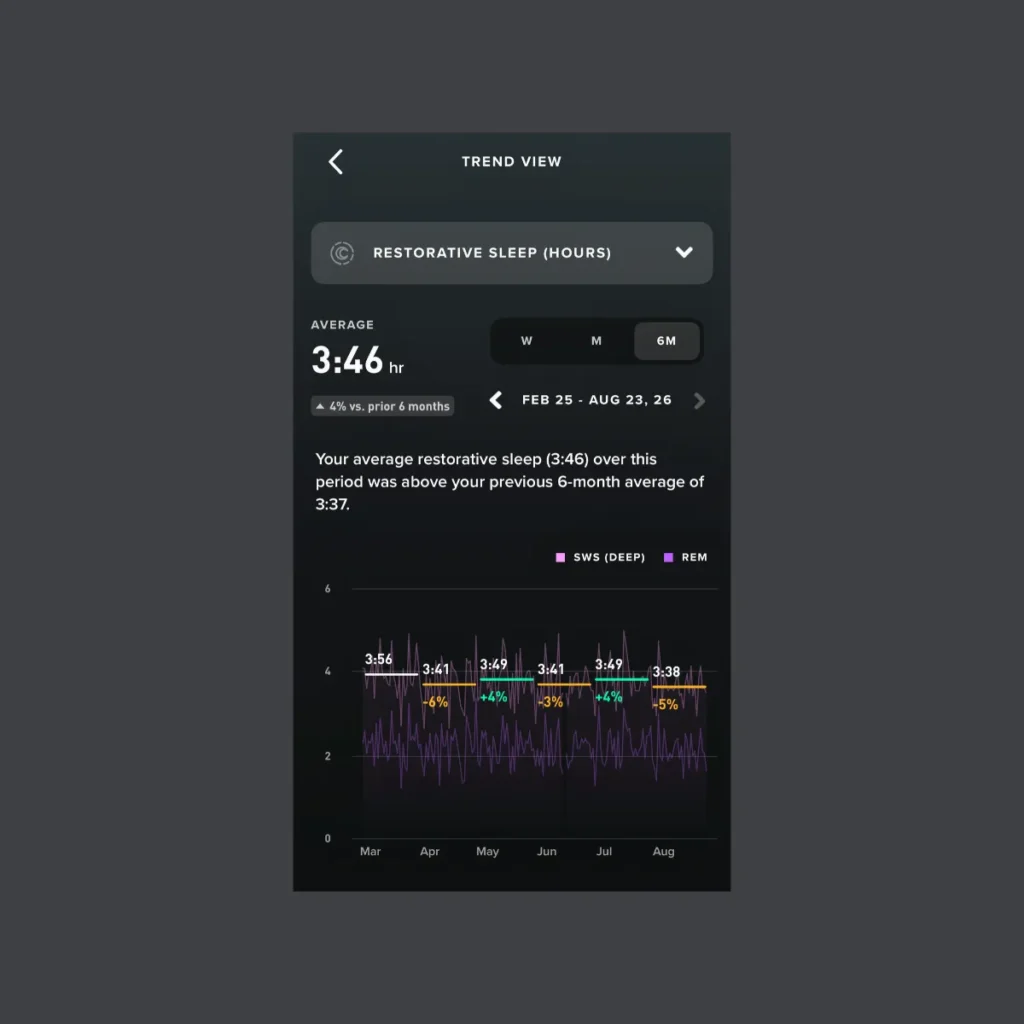
Over the last six months I’ve averaged 3 hours 46 minutes of restorative sleep a night — deep plus REM combined. Above the typical adult range, in a decade when it usually declines. I get there by practicing the same sleep habits consistently.
Quality sleep gave me the energy and recovery capacity for the last habit: consistent movement.
Most people start with exercise. I finished with it. Exercise is the habit that most depends on the others being in place — which is exactly why it’s the one people do first and the one that disappoints them.
Habit 4: Consistent Movement
I achieved most of my health goals — cholesterol and glucose in optimal ranges, weight, menopause symptoms — through diet alone. Energy and mood improved along with it.
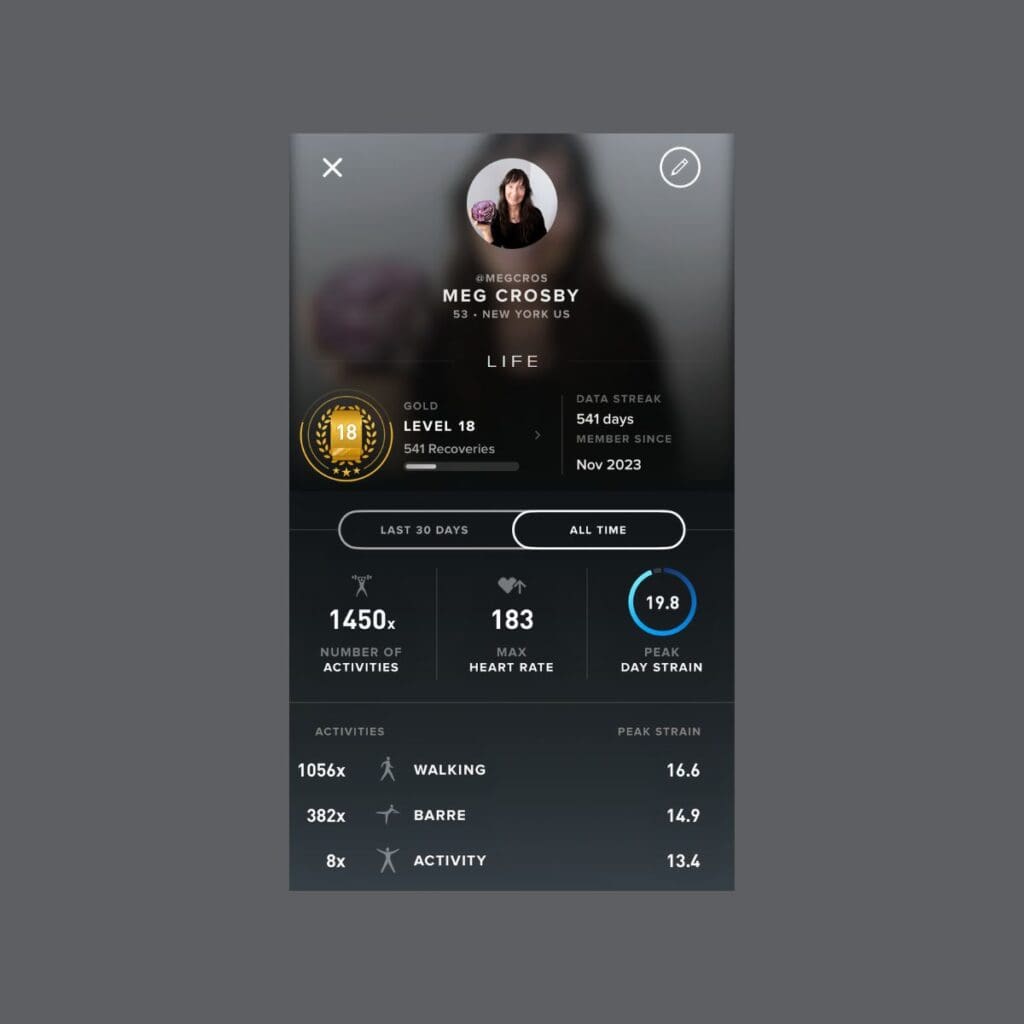
Movement was the last piece, and it wasn’t that I’d been still. I was already walking 7,000–10,000 steps a day and taking yoga once or twice a week. What changed in September 2022 was consistency: six Bar Method classes a week, held for three years. In December 2025 I went back to work and dropped to three, where I’ve been since.
The results have been measurable. My resting heart rate has come down from about 59 bpm when I started with Whoop in December 2023 to 52 today, with a low of 49.
What I Added After — And Why
One thing worth being clear about: none of the above includes weight training.
My Whoop Age had already read 9–10 years younger for over a year before I started training with weights. The four habits are what built that number.
Then in September 2025, I had my first DEXA scan. It came back with a lumbar spine T-score of -3.6 — osteoporosis. My Whoop Age read a decade younger that same month. Both were true. A wrist sensor tells you a lot about how you’re aging; it cannot see your skeleton.
So in October 2025 I hired a trainer. One hour a week, 5–8 reps, weights climbing 33–40% over each seven-week program. I’m 5’1″, about 105 pounds, and I’m deadlifting 85. I don’t enjoy it — which is precisely why there’s a trainer. I feel great when it’s over.
I’m including it here because the sequence matters. Data told me what was working. A scan told me what the data couldn’t see. Here’s what five months of weight training did.
What This Means for You
Your chronological age is not the full story. Health resources like Whoop provide greater insight into our key health metrics and the behaviors that lead to better, or worse, healthspan outcomes.
Can access to data increase the odds you’ll build and maintain healthy lifestyle habits? There’s only one way to find out.
Start here: pick the habit you’d rate lowest right now. Work on it for 30 days. Not perfectly, just consistently. That’s how each of mine started.
Thanks for reading!
Like this post? The newsletter is the blog, plus. Subscribe to You Are What You Read — one email a month on redefining your Next 50. Only what works.
References & Additional Reading
- Heart Rate Variability (HRV): What It Is and How You Can Track It – Cleveland Clinic
- An overview of heart rate variability metrics and norms – Frontiers in Public Health
- Role of plant-based diets in promoting health and longevity – Maturitas
- Healthy plant-based diets are associated with lower risk of all-cause mortality in US adults – Journal of Nutrition
- Natural Patterns of Sleep – Harvard Medical School
This post does not constitute medical advice. Please consult with your healthcare provider regarding your specific health needs.