


Read time: 5 minutes
Some people are born to lift heavy things. That person is not me. What I’ve learned in the last 5 months is this: one-hour torture sessions with my trainer, once a week, are doing what years of the exercise I love couldn’t.
It’s not just aesthetics (though I take motivation from wherever I can), it’s my metabolic health, bone health, brain health, independence, confidence — you name it.
If I can do it. You can do it.
We’re All Losing Muscle After 50
After age 30, we lose 3–5% of our muscle mass per decade. The rate accelerates after 60 and faster still after menopause. Without active intervention, this loss is silent, steady, and consequential — driving the metabolic decline, falls, fractures, and frailty most of us just think of as “aging.”
How to Maintain and Reverse Muscle Loss
The research is clear: maintaining lean mass after 50 requires three things working together:
- High-quality nutrition — nutrient-dense whole foods come first. When that’s dialed in and you’re lifting heavy, focus on balancing carbohydrates, fiber, protein and fat.
- Quality sleep — quality matters more than hours. Deep sleep and REM are when muscle repairs and grows, so a solid block of those beats a long but fragmented night. (Here’s how I improved mine.)
- Resistance training — and not just any resistance training. Progressive overload with heavy weights is the stimulus that maintains and builds muscle. Light resistance, endurance work, and bodyweight movement help, but they’re not the same stimulus.
If you’re doing some version of this and not getting the results you want, one of these three is the lever to adjust. For me, the gap was resistance training — specifically, the heavy progressive kind. I’d already optimized my nutrition and my sleep. Adding heavy lifting was the missing piece.
Why I Hired a Trainer
Three reasons:
1. A diagnosis I couldn’t ignore. In September 2025, at 53, I was diagnosed with osteoporosis — lumbar spine T-score of -3.6. Heavy resistance training is one of the most effective interventions for bone density. This wasn’t optional anymore.
2. I don’t like weights. Left to my own devices, I wouldn’t be lifting at all. My trainer isn’t just loading the bar past what feels comfortable — he’s getting me to lift in the first place. The accountability is the entire point.
3. Form and safety. This isn’t abstract. The last time I tried serious lifting — at Equinox with less experienced trainers, before I had real foundational strength — I got a femoral hernia. A qualified coach isn’t a luxury. They’re the difference between progress and an injury that sets you back months.
What I’m Doing With My Trainer
One session per week. 60 minutes. Heavy progressive resistance training.
Not all resistance work is equal. Here’s what separates heavy lifting from the rest:
- Compound lifts (squats, deadlifts, presses, rows) that load multiple muscle groups at once
- Low rep ranges (5–8) at challenging weights — the goal is strength and lean mass, not endurance
- Progressive overload across 7-week programs. My weights climb 33–40% over each cycle — then the entire program changes. New lifts every 7 weeks force my body to keep adapting instead of settling into a plateau. That constant novelty is a real part of why it’s working.
A recent workout (week 3 of a 7-week program):
Prep: Hip circles, PT frog stretch, reverse gastroc stretch, 10 bodyweight good mornings, 10 reverse nordics, 10 ATG split squats
Core: Dragonfly’s (10 reps), cable split-stance rotation (15 lbs, 10 reps)
Main lifts (2–3 sets — we run the full sequence, repeat it, then do a third round of select lifts):
- Barbell deficit reverse lunge — 35-lb bar plus 5 lbs per side (45 lbs total), 5 reps per leg
- Sumo deadlift — 85 lbs, 5 reps
- Lat pulldown — 35 lbs per side, 8 reps
- Incline chest press — two 15-lb weights, 8 reps
- Incline prone row — two 20-lb weights, 8 reps
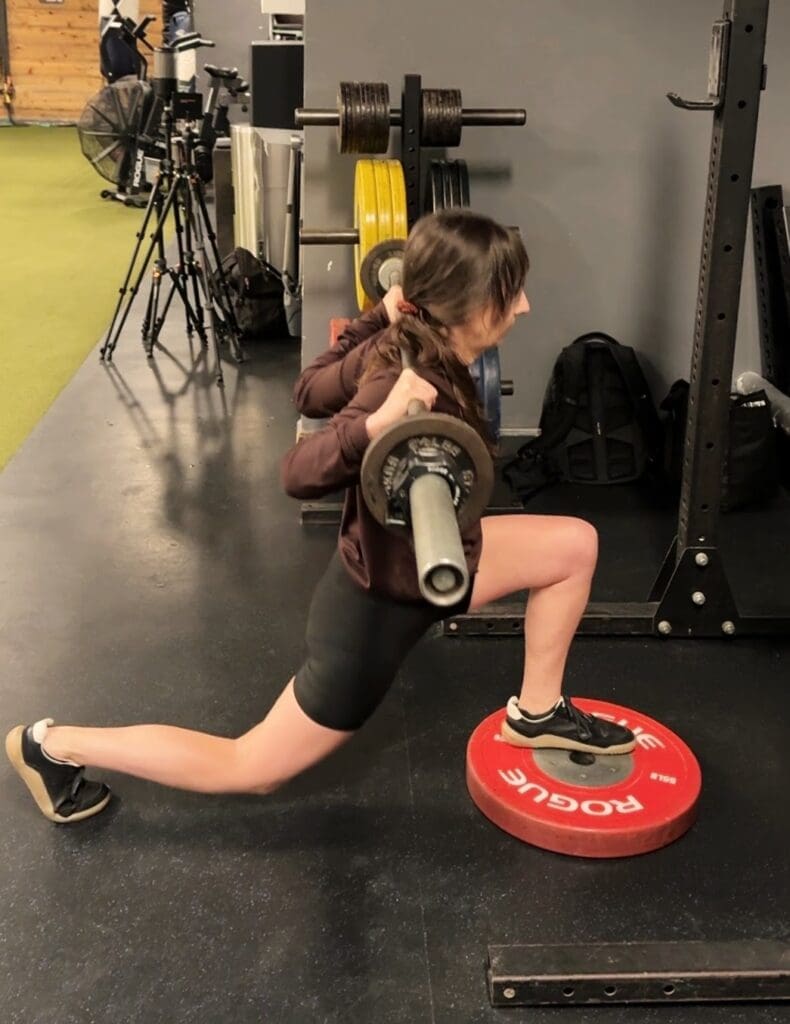
For perspective: at 5’1″ and around 105 lbs, an 85-lb sumo deadlift is approaching my bodyweight. This is the only training change I’ve made since October 2025. I still do Bar Method 3 days a week and walk daily (current weekly average of 13,000 steps per day).
My Results After 5 Months
Here’s what my four DexaFit body composition scans show:
| Date | Lean Mass | Body Fat | Body Score |
| Mar 5, 2024 | 71.4 lbs | 27.1% | A- |
| Dec 3, 2024 | 70.4 lbs | 29.5% | B |
| Jul 2, 2025 | 71.6 lbs | 29.9% | B+ |
| Feb 25, 2026 | 71.9 lbs | 28.5% | A- |
Between the last two scans, on the new training program:
- Lean mass: +0.3 lbs (now 0.5 lbs above my March 2024 baseline, and 1.5 lbs above my December 2024 low)
- Body fat: –1.4 percentage points
- Visceral fat: stayed in the “excellent” range (under 0.5 lbs) across all four scans
- Body score: B+ back to A-
According to my physical therapist, building lean mass while losing fat — true body recomposition — is hard to achieve. I did it in 5 months by adding one hour a week of heavy lifting.
Am I worried about getting bulky? Not at all. My numbers show the opposite — leaner and stronger, not bigger.
Where to Start
I’d love to tell you that your favorite form of exercise is enough. Mine is yoga, barre, walking. It probably I’d love to tell you that your favorite form of exercise is enough. Mine is yoga, barre, walking. It probably isn’t. Heavy lifting is the stimulus that builds and preserves lean mass after 40 — and the data shows I’m not just holding ground. I’m above where I started.
If a trainer isn’t accessible to you right now, the principles still work without one: study form carefully for each lift, start with weights that feel manageable, and add load week over week. Progressive overload is what matters most.
But a good trainer accelerates everything — accountability, pushing you past your comfort zone, expert form, and a program built around your goals.
It’s never too late to start. At 54, I’m lifting weights I never imagined I could.
The Hardest Part Is Mental
“I can’t” is “I don’t think I’m capable” in disguise. Confidence is doing the thing you just said you couldn’t do.

I know this firsthand — we all hit it in some corner of our lives. I can’t recall a single session in the last 5 months where the words “I can’t do that” didn’t come out of my mouth. Then I did it.
You can too.
Thanks for reading!
Like this post? Get more. Subscribe to You Are What You Read — one email a month on redefining your Next 50. Only what works.
References & Additional Reading
- Wilkinson et al. (2018). The age-related loss of skeletal muscle mass and function. Ageing Research Reviews.
- Hong & Kim (2018). Effects of resistance exercise training on bone health. Endocrinology and Metabolism.
- Schoenfeld et al. (2017). Resistance training volume and increases in muscle mass. Journal of Sports Sciences.
- Sipilä et al. (2020). Muscle and bone mass in middle-aged women: menopausal status and physical activity. Journal of Cachexia, Sarcopenia and Muscle.
This post does not constitute medical advice. Please consult with your healthcare provider regarding your specific health needs.
Image credit: Samuel Kambu