


Read time: 4 minutes
Three pieces of banana bread. After dinner. I’m a small person. Obviously it was good.
I was prepared for Whoop to hand me a bill the next morning.
It didn’t.
The metric that tells on you
Resting heart rate is the simplest recovery metric you have, and you don’t need a wearable to track it. Mine comes from my Whoop.
A 60-second pulse check first thing in the morning, before you get out of bed, gets you close.
Either way, it reflects how hard your body is working when it should be at rest. When it runs above your baseline, something interfered with your recovery.
A drink, a late meal, takeout — these show up as an elevated RHR because your body is busy processing what you gave it instead of shifting into repair mode. Restaurant meals reliably raise my RHR. Meals I make myself, from whole plant foods, don’t.
If you’re like most people, you have no idea what your food choices are doing to your sleep. The data is available. It’s on your wrist.
Getting curious is the assignment.
The morning after the banana bread, I ran the test: opened my Whoop app to see what the damage was.
What the data showed
- Resting heart rate: 54. My monthly average is 54. No movement at all.
- Sleep performance: 100%.
- Time awake: 33 minutes, below my typical range.
- Deep sleep: 1 hour 45 minutes, at the top of my typical range.
- REM: 2 hours 9 minutes, at the midpoint of my typical range.
- Sleep stress: 0%.
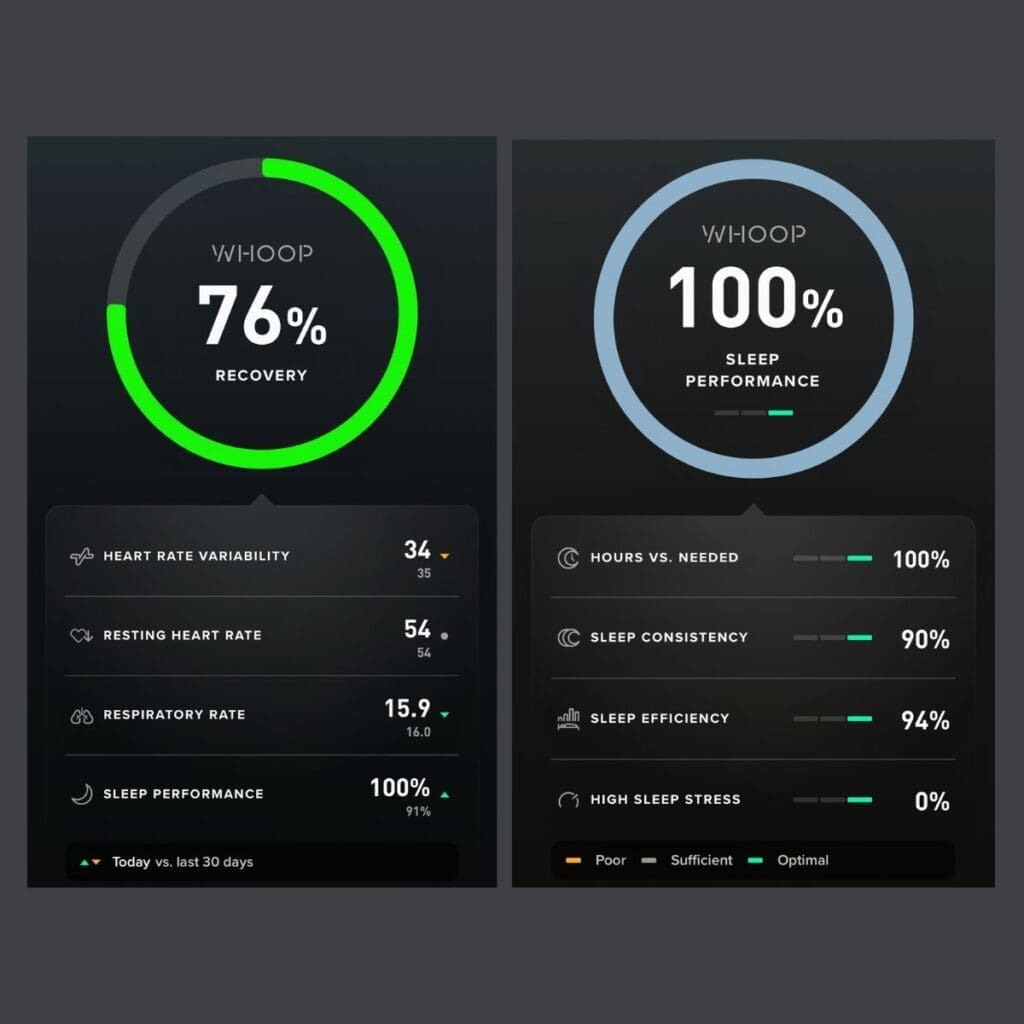
Not one metric moved in the wrong direction.
I’m not claiming banana bread improves sleep. This is about what healthy ingredients buy you.
One piece of the bakery version, same 7pm (refined flour, sugar, whatever oil was cheapest), and my bet is your RHR notices. Three pieces of mine? No impact.
Why I think it didn’t budge
Three things were true about this bread, and they mattered more than the quantity:
It’s made of ingredients your body loves. Bananas, buckwheat flour, oats, ground flax, applesauce, cinnamon. No oil. No butter. No added sugar. Compare that to a bakery loaf and you’re looking at two different foods wearing the same name.
Your body processes three pieces of one very differently than one piece of the other. There’s science behind this: in a Columbia University study, more fiber predicted deeper sleep, while more saturated fat and sugar predicted lighter, more disrupted sleep.
The timing helped. I ate it around 7pm, right after dinner, which gave my body about 3 hours to digest before bed. That lines up with what sleep experts recommend: finish eating at least 2 to 3 hours before bedtime. Eating earlier helps. What’s in the food matters more.
It was never a “bad” choice to begin with. That’s the real lesson of checking my resting heart rate. I assumed even my own bread, at this quantity, would register somewhere.
It didn’t, because three pieces of bananas, oats, and flax is closer to a bowl of oatmeal than to cake.
More than a decade of eating this way says it wasn’t a lucky night, either. The food rules in your head have categories like “dessert” and “too much.” Your body only has ingredients.
Run your own experiment
Change what you eat, and watch what happens. Pick a few dinners this week and make them yourself, from whole plant foods. Nothing fancy. This is an experiment, not a cooking show. Keep everything else steady: same bedtime, no alcohol, no new variables. Then check the morning data. Your RHR if you track it, how you feel at 7am if you don’t.
I’ve run this experiment on other people. When I designed a week-long wellness retreat for my parents, I changed one thing: what they ate. One week. Measurable change.
You might find your usual dinner has been costing you more than you knew. Good. That’s a fixable problem.
So here’s where I landed: I ate something I love, more of it than I usually do, and the bill never came.
No elevated RHR. No restless night. No morning-after food coma. When the ingredients are ones your body loves, there’s nothing to pay off.
And that RHR of 54? For a 54-year-old woman, that’s a number that tells me my choices are working. But that’s another post.
Stay curious. Your body has a lot to tell you.
(Recipe coming to the blog soon.)
Thanks for reading!
Like this post? Get more. Subscribe to You Are What You Read — one email a month on redefining your Next 50. Only what works.
References & Additional Reading
- Your resting heart rate can reflect your current and future health — Harvard Health
- Fiber and Saturated Fat Are Associated with Sleep Arousals and Slow Wave Sleep — Journal of Clinical Sleep Medicine
- Is Eating Before Bed Bad for You? — Cleveland Clinic
This post does not constitute medical advice. Please consult with your healthcare provider regarding your specific health needs.
Image credit: MART PRODUCTION